The Fortress of the Spirit against the Regime
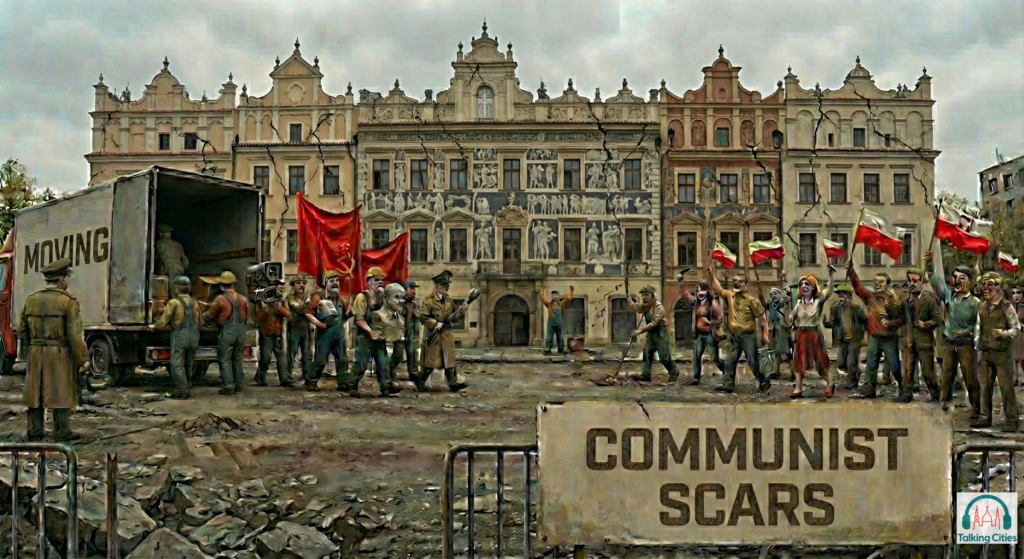
While Warsaw was rebuilding itself to be the administrative center of communist Poland, Kraków chose a different path. In this city, resistance was not fought only in offices, but in the defense of its identity. Kraków acted as the spiritual lung of the nation between 1945 and 1989, leaving a visible legacy in its streets that speaks to us, not of pain, but of an unbreakable will to be free.
Nowa Huta: The Cross that Challenged Concrete.
The most imposing testimony of this era is found in Nowa Huta. Built by the regime as an ideal satellite city and a working-class counterweight to “bourgeois and intellectual” Kraków, it was designed to be a city without religion. However, social engineering underestimated the identity of its inhabitants.
The turning point occurred in 1960, at the intersection where neighbors defended a simple wooden cross against the bulldozers that intended to build an ideological school. That defense culminated years later in the consecration of the “Arka Pana” (Lord’s Ark) church. Its architecture, clad in river pebbles and shaped like an ark, breaks with the gray monotony of Soviet blocks. Today, visiting this temple is entering a refuge that literally served to protect protesters from police charges, a space where faith won the match against authoritarian urbanism.
Szewska Street and the Student.
Echo The Old Town of Kraków hides stories of an abrupt awakening. In May 1977, the death of student Stanisław Pyjas, linked to the secret police (SB), forever transformed the university atmosphere.
Far from silencing the youth, this event lit the fuse of public organization. In response, the Student Solidarity Committee (SKS) was born in Kraków, the first independent organization of its kind in the Eastern Bloc. Walking today around the Jagiellonian University, one can perceive the echo of those students who, instead of celebrating official holidays, chose to create networks of self-education and clandestine libraries, sowing the seed of civil society.
Wiślna and Kanonicza: Trenches of Ink and Art.
Kraków’s resistance was also intellectual and aesthetic. In the offices of Wiślna Street, the weekly Tygodnik Powszechny remained a beacon of free thought, being the only independent Catholic publication allowed between Berlin and Vladivostok. Under the direction of Jerzy Turowicz, and with the support of Karol Wojtyła from Kanonicza Street, this circle kept Poland connected with Western culture.
In parallel, the theater of Tadeusz Kantor and his group Cricot 2 challenged socialist realism through art. Works like The Dead Class did not need political pamphlets; their mere existence and creative freedom were an act of dissent.
Touring Kraków with the eyes of recent history is discovering a city that never allowed itself to be redefined. Its buildings and monuments are not just stones; they are the evidence of a society that, faced with the imposition of a “new man,” decided to remain itself. At Talking Cities, Kraków tells us the story of how culture and spirit can be the hardest walls to tear down.
The Fortress of the Spirit against the Regime