The Hidden Garden Behind the Bricks
The Double Life of the Church of Our Lady of Częstochowa
If you stroll through the Old Town of Zielona Góra, it is impossible to miss. Along with the Town Hall and the Co-Cathedral, its tower defines the city’s skyline. But the Church of Our Lady of Częstochowa is much more than just a pretty postcard; it is a survivor with a fascinating identity crisis.
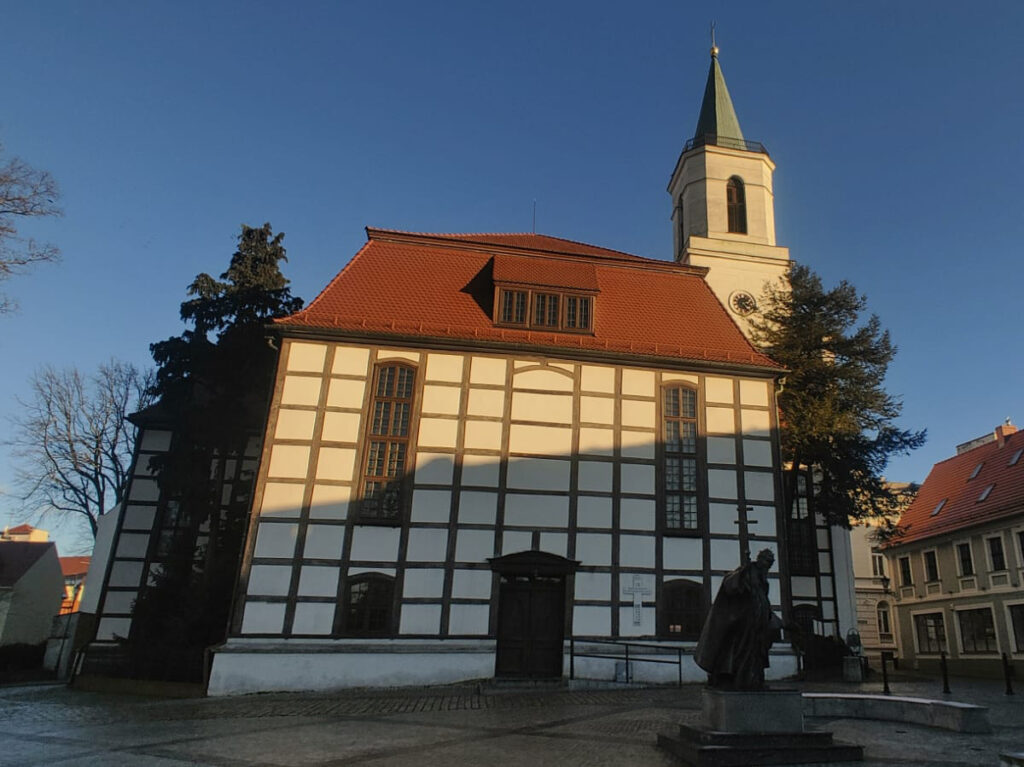
At first glance, it looks like just another Catholic church in devout Poland. But if you get close to its walls and touch the structure, you will notice something strange: it isn’t made of solid stone. It is a giant of wood and brick that hides a Prussian secret in its heart.
A Church Built from Walls
Let’s travel back to 1747. Silesia has just changed hands: from Catholic Austria to the Protestant Prussia of Frederick II the Great. The Lutherans of Zielona Góra, who for years were forbidden from building temples inside the city, finally get the green light.
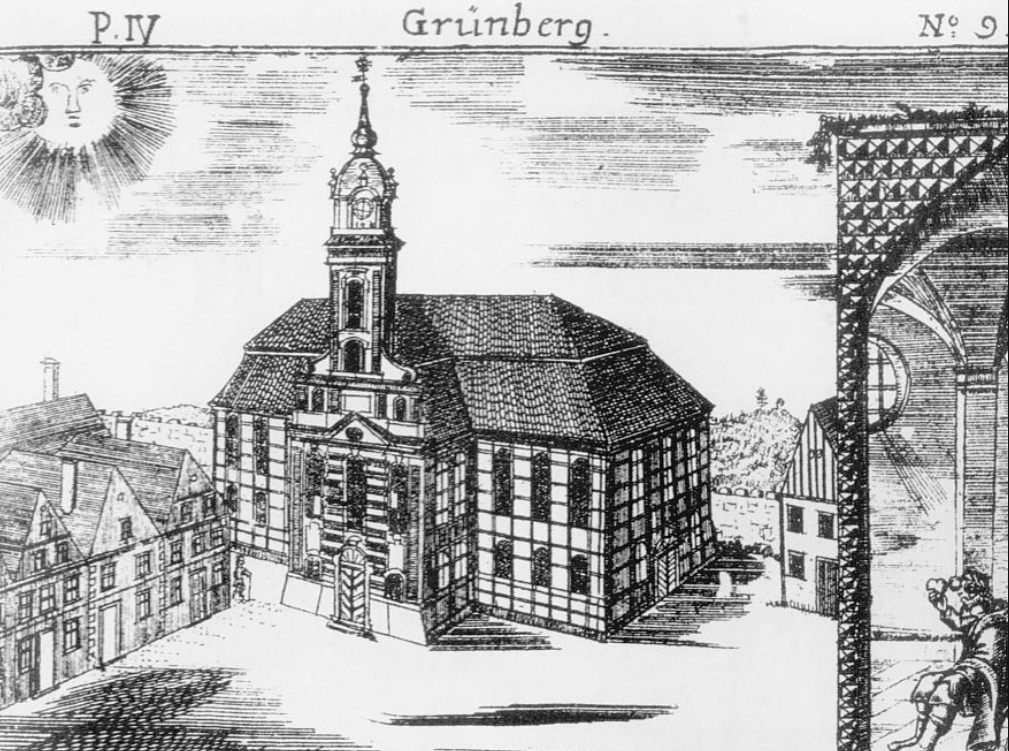
But there was haste and a need for pragmatism. The solution? To build a half-timbered structure (Fachwerk)—today the largest of its kind in the entire Lubusz region—and fill it with bricks.
Here lies the poetic irony: many of those bricks came from the city’s ancient defensive walls, which were being demolished in the 18th century. What once served to separate and defend was used to build a place of gathering.
The Theater of the Word
Crossing the threshold, forget for a moment what you know about traditional Catholic churches. Don’t look at the altar just yet; look up.
Surrounding you are impressive two-story wooden galleries. This design is not accidental; it is 18th-century social engineering. Originally, this building was an Evangelical church designed as an auditorium. The priority was not to see the Eucharist, but to hear the sermon.
In its heyday, this space could seat nearly 2,000 people. Imagine the creaking of the wood and the murmur of the local clothiers’ guilds, leaning over the balconies as if they were in an opera house, focused entirely on the spoken word.
The Secret Under the Pulpit: “Christ’s Garden”
Here is where we challenge you to be a keen observer. Walk towards the pulpit (the elevated platform for preaching) and look closely at its base.
It is not just any column. It is a palm tree trunk carved in wood.
What is an exotic palm tree doing in the middle of cold Silesia? It is the only visible trace of the church’s original name: Zum Garten Christ (“The Garden of Christ”). For the old Lutheran Pietists, faith was an inner garden that had to be cultivated, and the righteous would “flourish like the palm tree.”
Although today the Baroque high altar and Catholic iconography dominate the view, that little palm tree is still there, supporting the pulpit, reminding us of the building’s theological origin.
From Prussia to Poland
History rewrote the building. In 1828, the classicist tower was added to assert its presence in the city. After World War II, with the shifting of borders, the temple passed into Catholic hands and adopted the name of the patroness of Poland: Our Lady of Częstochowa.
For decades it functioned almost incognito, as a branch of the neighboring parish, until it reclaimed its place as an independent parish in 1987. Renovations in the 1980s saved it from ruin caused by dampness, allowing us to enjoy this historical hybrid today.
Why Visit?
Because it is an honest building. It doesn’t hide its scars or its changes. It is a place where an organ with a 1752 Baroque case coexists with a 20th-century Romantic sound; where the Protestant structure hosts Catholic liturgy; and where, if you pay attention, you can still feel the atmosphere of the old “Garden of Christ.”
📍 Where to find it: Right in the heart of Zielona Góra, just a few steps from the Town Hall.
💡 Talking Cities Tip: If you are lucky and someone is playing the organ, go inside and sit down. The acoustics of the wood are warm and enveloping, very different from the cold stone of Gothic cathedrals.