The Smile That Disarmed the System
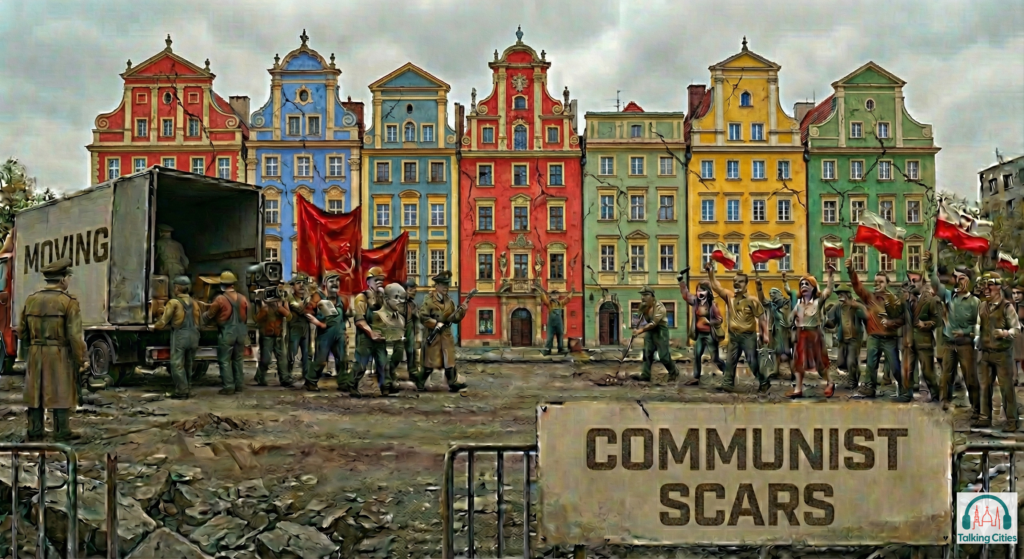
If Warsaw negotiated in offices and Kraków prayed in cathedrals, Wrocław chose a path no one saw coming: subversive laughter and radical struggle. In this western city—a “no man’s land” repopulated almost entirely after the war—resistance did not carry the weight of ancient tradition. Perhaps for this reason, its inhabitants felt free to invent the most audacious ways to defy power. Wrocław was not just an anti-communist bastion; it was the laboratory where surrealism became a political weapon.
The Dwarf Revolution on Świdnicka Street
Walking down Świdnicka Street today is, quite literally, stumbling upon history. Small bronze statues of gnomes (krasnale) watch us from the corners. To the unsuspecting tourist, they are a cute attraction, but to us, they are the veterans of a unique psychological war.
In the greyness of the 1980s, the Orange Alternative (Pomarańczowa Alternatywa) was born here. Led by “Major” Waldemar Fydrych, this movement decided that the only way to fight an absurd dictatorship was with even greater absurdity.
The pavement of Wrocław was transformed into a theater of the ridiculous. When the police scrubbed out an anti-government slogan, Fydrych and his crew would paint a dwarf over the patch of fresh paint. When the regime organized pompous military parades, they counter-attacked with marches of people dressed as gnomes or by handing out toilet paper—a luxury good at the time—as if it were a sacred relic. The police were paralyzed: how do you arrest a dwarf for smiling? By breaking fear through laughter, Wrocław exposed the emperor in front of his people.
The Other Side: Fighting Solidarity
But beneath that layer of humor, Wrocław had a core of steel. While the rest of Poland sought compromise and dialogue, the most intransigent faction took root here: Fighting Solidarity (Solidarność Walcząca).
Under the leadership of Kornel Morawiecki, this organization rejected the idea of sitting at the table with the communists. For them, there was no possible “socialism with a human face”; the goal was total independence. This stance turned the city into a fortress of underground technology. From hidden basements, they operated pirate radio stations that interfered with state television signals and ran counter-intelligence networks so sophisticated that the secret police (SB) could barely infiltrate them.
In this game of chess, the Church also played a movie-worthy hand. The figure of Cardinal Henryk Gulbinowicz is legendary in the city, not only for his spiritual work but for an audacity worthy of a spy novel.
Days before Martial Law was declared in 1981 and the State froze the union’s accounts, local Solidarity leaders withdrew 80 million zlotys and took them… to the Archbishop’s palace. Gulbinowicz hid the cash, and that “treasure” funded the underground resistance and provided aid to the families of the persecuted during the regime’s darkest years.
Wrocław teaches us that identity is not inherited, it is built. In a city where everyone was “new” after 1945, a community was forged, united by the rejection of lies. Today, its bronze gnomes are not toys; they are monuments to human wit. They remind us that, even when facing tanks, sometimes the most powerful weapon is the ability to laugh in the tyrant’s face and keep the radical hope of freedom alive.
The Smile That Disarmed the System