The Silenced Scream That Awakened a Nation
On the map of Polish dissent, Warsaw was the political brain and Kraków the spiritual heart. But Poznań was the nervous system that, after receiving the first electric shock, learned to resist with a unique blend of rage and pragmatism. In this city, historically marked by Prussian order and the ethos of “organic work,” the pavement of Mickiewicz Square holds not just the memory of a tragedy, but the history of how an entire society learned to organize in the shadows.
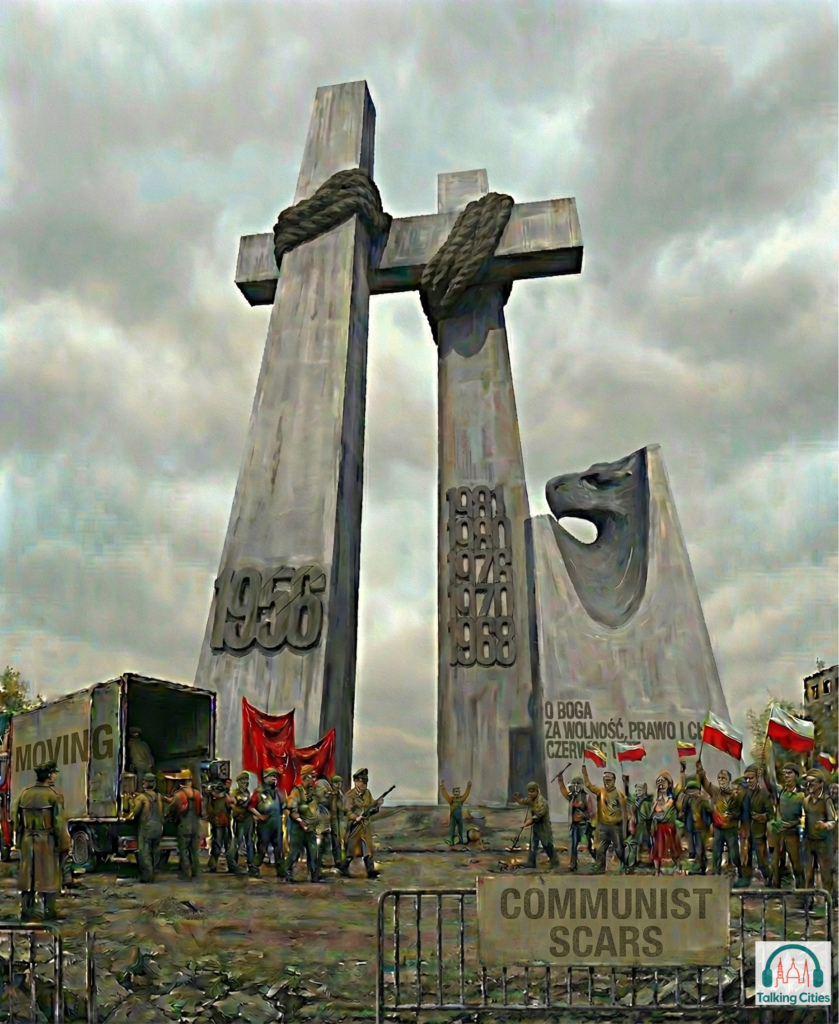
Walking today before the Monument to the Victims of June 1956—two immense steel crosses bound together by a rope—is to face the first real crack in the Iron Curtain. But to understand its weight, one must listen to the silence that preceded the scream. On June 28, 1956, at six in the morning, Poznań’s proverbial discipline shattered when workers at the H. Cegielski factories stopped their machinery under the slogan “Bread and Freedom.” The protest, initially peaceful, transformed into an urban battle when the crowd stormed the prison on Młyńska Street and besieged the headquarters of Public Security.
The regime’s response destroyed the myth that communism represented the working class: they sent 400 tanks and 10,000 soldiers against the workers. Among the at least 58 fatal victims fell Romek Strzałkowski, a 13-year-old boy who became the symbol of executed innocence. His death marked the beginning of a “second occupation”: that of silence. For a quarter of a century, the government forbade speaking about what had occurred, forcing the city to become the clandestine guardian of its own history, applying the logic of building itself better than the enemy through networks of self-help and communal survival.
In this ecosystem of apparent order, art played a crucial subversive role. The Theatre of the Eighth Day (Teatr Ósmego Dnia) emerged from the student counterculture to become the aesthetic nightmare of the secret police (SB). Under the direction of visionaries like Lech Raczak and Ewa Wójciak, the group took theater out of closed venues and into the streets and churches.
Their work was not mere entertainment, but an act of public accusation. The surveillance upon them was so obsessive that, paradoxically, it became artistic material: years later, they would create the play Teczki (The Files), using the actual reports that informers had written about their lives, transforming police repression into a theatrical script and proving that the truth always finds a crack through which to escape.
If the factories provided the strength and the theater the voice, the Church provided the intellect. In Poznań, the Dominican monastery functioned as a static “Flying University,” with the central figure of Father Honoriusz Kowalczyk. In the cloisters, far from censorship, the true history of Poland—erased from official textbooks—was taught.
Father Honoriusz paid the highest price: his death in 1983, following a mysterious car accident, was interpreted by the city as a political assassination. However, his legacy endured. During martial law, the Dominican church was not only a place of prayer but the logistical center from which aid was distributed to the families of internees and peaceful resistance was organized.
Poznań teaches us a vital lesson about urban memory. Its monuments do not celebrate military victories, but the dignity of standing firm. Walking its streets today, the city speaks to us of a resistance that did not need to be loud to be unbreakable. It was here, between order and fury, that the silenced scream of workers ended up awakening the conscience of an entire nation.
The Silenced Scream That Awakened a Nation