St. Hedwig’s: The Building That Refused to Die
And What Its Scars Tell Us
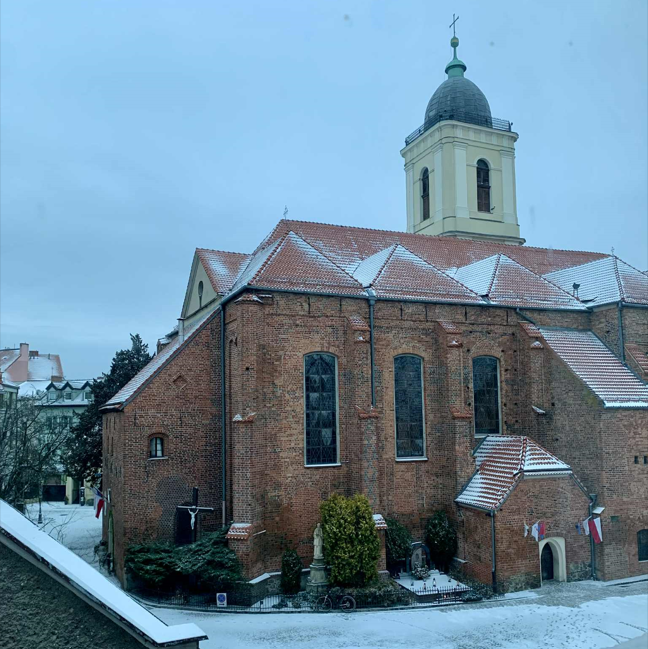
If you walk through downtown Zielona Góra, you are bound to end up standing in front of St. Hedwig’s Co-Cathedral (Konkatedra św. Jadwigi). Guidebooks will tell you the usual story: it is the oldest building in the city, its foundations date back to the 13th century, and it is the pride of local Gothic architecture. They are right, but that is the boring version of the story.
The truth is that this building is not a dignified elder that has aged in peace. It is a survivor. A bruised witness that has withstood structural collapses, fires, and religious identity crises.
If you pay attention, the stones will tell you a very different story from the official brochures. Here, I invite you to read the scars of the “Grandmother of Zielona Góra.”
The Scar of 1776: When the Sky Fell
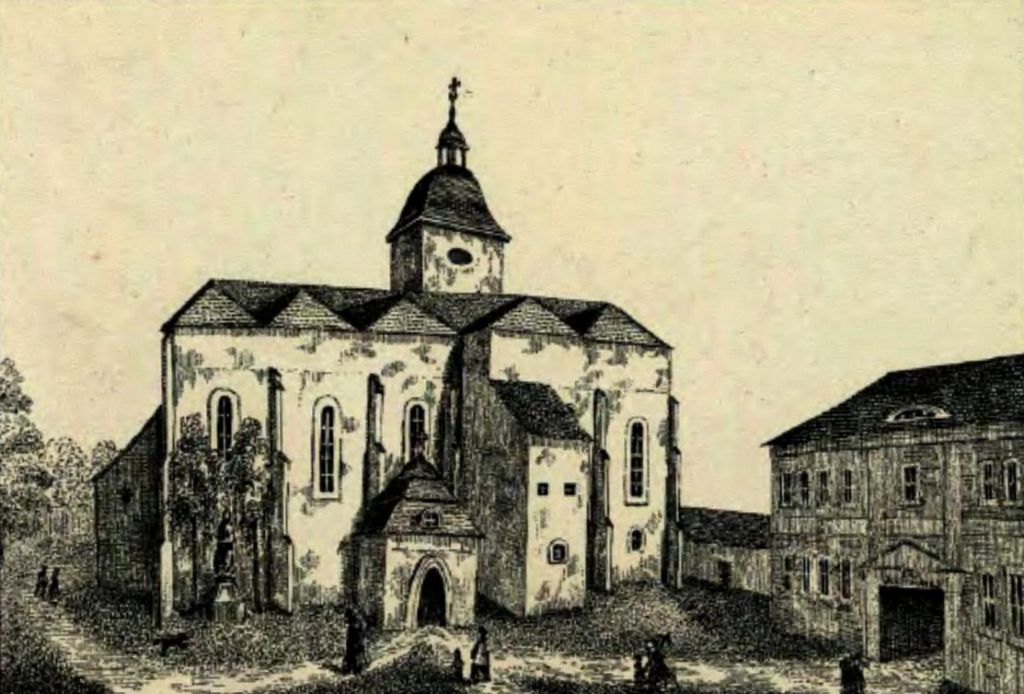
The first thing you must do is look at the tower on the north side. Notice anything odd? Its clean, orderly Neoclassical style clashes violently with the rough Gothic masonry of the rest of the church. This isn’t the whim of an avant-garde architect.
It is the memory of a disaster. On July 14, 1776, the original Gothic tower collapsed. Imagine the roar: tons of stone crashing down onto the nave, crushing the vault and destroying centuries of history. What you see today is the emergency reconstruction (finished in 1832).
This temple is like the mythical “Ship of Theseus”: after three devastating fires (in 1582, 1651, and 1683) and a massive collapse, is it still the same church? Probably not, and that is what makes it fascinating. It is a daughter of fire just as much as of faith.
An Unexpected Tenant: The Protestant Interlude
Enter the main nave. It smells of incense, and you see Catholic iconography everywhere. You assume it has always been this way, right?
Wrong. For over a century, from 1525 to 1654, these walls heard sermons in German and followed the Lutheran liturgy. Zielona Góra (then Grünberg) was a Protestant stronghold, and this temple was its heart.
It didn’t become Catholic again through a mass spiritual conversion, but through Habsburg politics. After the Thirty Years’ War, they took the building back as an ideological trophy. Under the floor you walk on, layers of history mix German, Polish, Protestant, and Catholic identities. It is a theological battlefield turned into a monument.
The Controversy of the 70s: Ugliness or History?
Walk toward the main altar and prepare for a visual shock. Amidst the ancient solemnity, you are met with an altar installed in the 1970s.
Many locals (they might even tell you this over coffee) hate it. They say it doesn’t fit, that it breaks the harmony. They miss the old wooden one. But before judging it, understand its context. That harsh-lined altar is not a decorating mistake; it is the Church’s answer to Vatican II.
It represents a moment when the institution was desperately trying to modernize, stripping away “Baroque excess” to focus on the community. It might not be “pretty” in the classical sense, but it is honest: it represents the crisis and the search for relevance of the faith in the 20th century.
Secrets in Plain Sight
Before you leave, look for two details most people miss:
The Industrial Organ: Look up at the choir. The organ casing is from 1912, built by the legendary firm Schlag & Söhne. It isn’t just an instrument; it is proof of the industrial power of pre-war Silesia, famous worldwide for its musical engineering.
The Ogrójcowa Chapel: On the south side, this small space has lived a thousand lives. It was a religion classroom, a refuge for the Greek-Catholic minority, and today it holds relics of John Paul II and Blessed Jerzy Popiełuszko. It is a tiny corner with huge historical density.
Co-Cathedral?
One last fact for your visit: the title “Co-Cathedral” sounds imposing and ancient, but it is an administrative invention from 1992. Before that, for 700 years, it was simply the town parish.
So, when you visit St. Hedwig’s, don’t just look at a religious building. Look at a map of scars. Look at a place that refused to disappear, reinventing itself with every fire, every war, and every border change. That is what truly gives it a “heart.”